Spin State Control: Engineering Electronic Ground States
A defining feature of the our research is the use of electron state as a primary design element in catalysis. This tunable variable can be manipulated to unlock new chemical reactivity and physical properties.
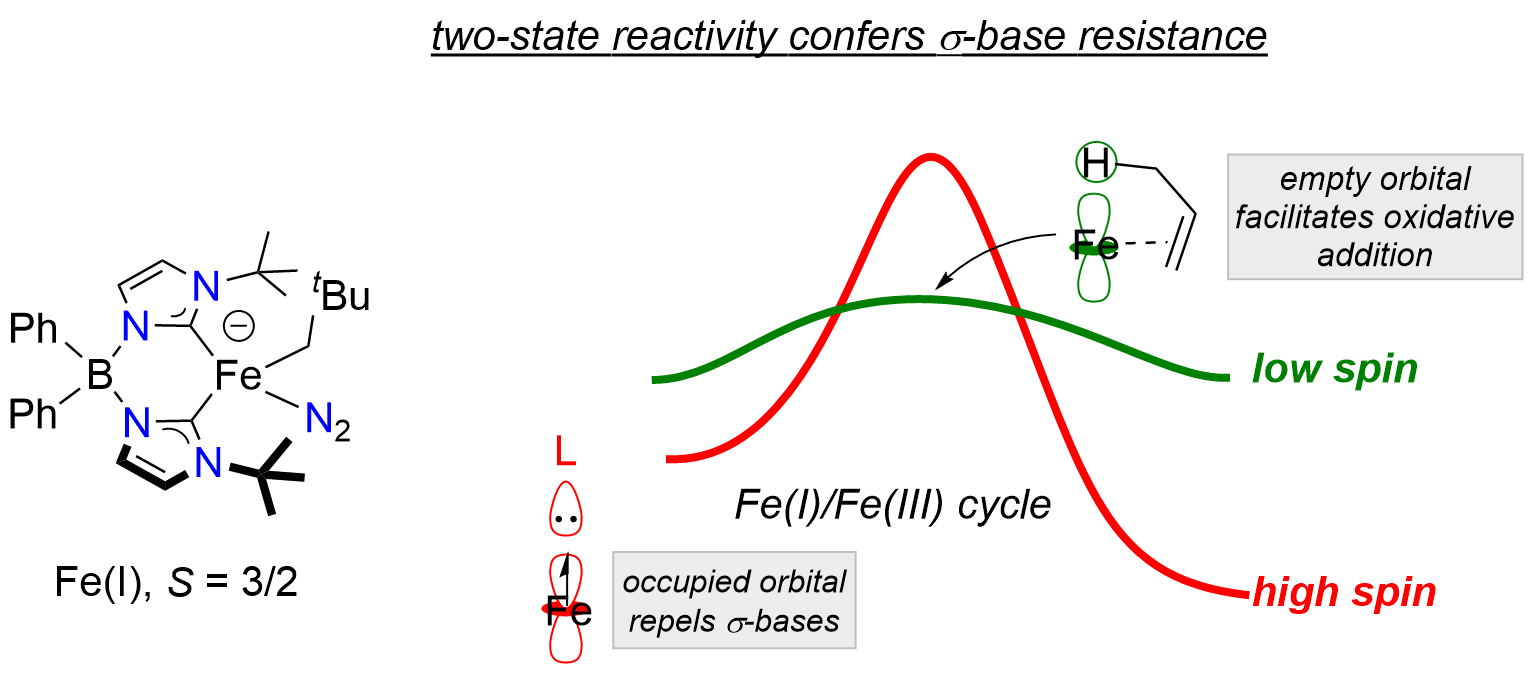
"Two State Reactivity"
In many catalytic cycles, the ground electronic state of a catalyst is unreactive toward specific steps in a reaction. We design catalysts that can cross between different spin surfaces during the reaction, allowing them to leverage the properties of multiple electronic states.
- Design: By carefully designing the ligand field, we create catalysts where the energy barrier to switch spin states is thermally accessible.
- Application: In alkene isomerization, this spin-crossover acts as a "gate." The high-spin ground state prevents the catalyst from being poisoned by strong bases, while the reactive low-spin state is only accessed when the correct substrate binds.
High Spin Complexes with Metal-Ligand Multiple Bonds
Historically, iron imido (Fe=NR) complexes are active in nitrene group transfer catalysis. By engineering the coordination environment to stabilize a high-spin (S = 2) iron(II) state, we have unlocked new reactivity in which the metal and imido ligand act cooperatively in catalysis.
- Breakthrough: These high spin complexes exhibit nucleophilic behavior at the imido ligand, allowing them to perform unprecedented transformations like double bond transposition and hydrogen isotope exchange. This fundamentally expands the toolkit of iron imido catalyst reactivity.
- Extension: Oxygen atom insertion from high spin (S = 2) iron(IV) oxo complexes enables new catalysis for the synthesis of phenols.